Group

With the revision of the EVB-IT contract templates for open source software, the Federal Ministry for Digital and State Modernization (BMDS), together with the digital association Bitkom, has improved the conditions for more practical OSS procurement in public administration.

In conjunction with the joint implementation of the Germany stacks it becomes clearer what is important for digital sovereignty: robust procurement channels, open standards and connectable platform architectures.
Digital sovereignty is politically desirable, but is often not yet firmly anchored in practice. The further development of the EVB-IT for open source software creates better conditions for more reliable procurement and use of open software in public administration, without fundamentally excluding proprietary software.
At the same time, the German stack will make it clearer how public administration should be structured technically and organizationally in the future: interoperable, reusable and connectable via common basic components. On March 18, 2026, the IT Planning Council declared the standards of the Deutschland stack to be binding; at the same time, the BMDS describes the platform core as the basis for central solutions for identity, data exchange, data retrieval, payment processing and notification.
The revision of the EVB-IT contract templates for open source software is an important step, as it addresses one of the crucial points: procurement. As long as open software is politically desirable but structurally disadvantaged in procurement, digital sovereignty will remain piecemeal.
If open source is taken into account more systematically and with greater legal certainty in standard contracts, this will improve the conditions for an administration that not only uses technologies, but can also control, develop and adapt them in the long term. Open source will not automatically become common practice everywhere, but it will lose some of its status as an exception in established procurement logics.
Open software alone does not make for sovereign administration. If systems are not interoperable, interfaces remain inconsistent and basic services are developed several times in parallel, new dependencies and new isolated solutions are created.
The Germany stack is intended to create a common basis so that digital administrative services no longer exist side by side, but fit together better. Open interfaces, uniform standards and reusable basic services are crucial for this.
This makes it clear that digital sovereignty is not just a question of source code. It is also a question of architecture.
The EVB-IT contract templates primarily concern the conditions under which open source software can be procured, developed and maintained in a legally secure manner. The Germany stack concerns the technical and organizational logic according to which these solutions should be connectable, reusable and scalable.
An administration does not become sovereign if it purchases open software but works without common standards and platform principles. Nor does sovereignty arise if standards are defined but the technologies used continue to create dependencies and a lack of transparency.
The current status of the Germany stack make this connection very clear: API-first, end-to-end digitalization, managed services only, publication on open code, open standards, open interfaces and primarily open source or sovereign offerings are not individual ideas. Together, they form the foundation of a connectable ecosystem.
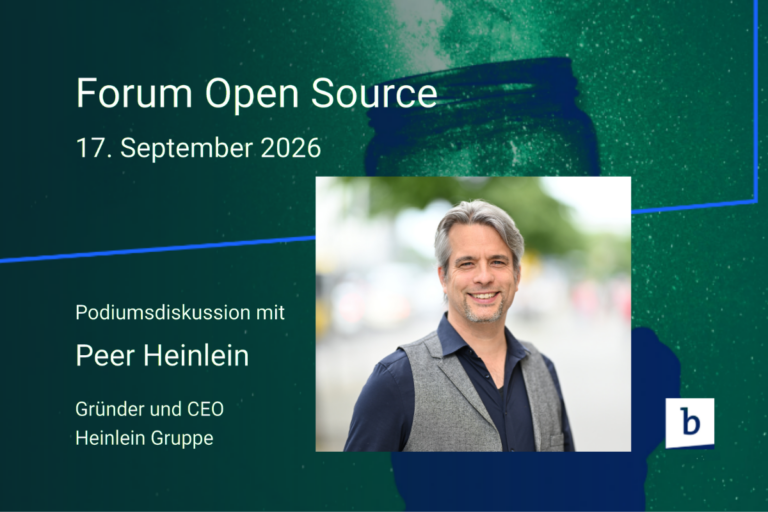
For the Heinlein Group, this development confirms a principle that we have been advocating for years: Digital sovereignty is not created through symbolic politics, but through technical and organizational decisions that actually enable openness.
If you want to make public IT fit for the future, you have to take three things seriously at the same time: transparent and controllable software, open and documented standards and a reliable framework for procurement and operation. This is precisely why it is not enough to simply state that open source is desirable. It must be written into the processes, contracts and platform architecture.
With its products and subsidiaries, the Heinlein Group already offers components that address the central requirements of the German stack: sovereign e-mail infrastructures with mailbox, collaboration platforms with open standards for video conferencing and file management with OpenTalk and OpenCloud as well as hosting and operation under German or European jurisdiction with Heinlein Support.
The further development of the EVB-IT contract templates for open source software is an important step because it addresses a central problem: How can open software be procured in the public sector in a legally secure and practicable manner? However, this change will only become fully significant together with the German stack. Only open standards, common basic components and connectable platform architectures can turn sovereign procurement into sovereign administrative IT.
Anyone who wants to reduce digital dependencies must finally treat open source, standards and procurement as a coherent task.